Our volunteers finished work on the site last Friday. One of the really important aspects of this excavation has been the way that everything - from doing the initial clean to setting out the grid, drawing the plans, taking levels, digging the features, taking site photographs and filling out the record sheets - has been done by the volunteers. The professionals have been on hand to guide them every step of the way, but our volunteers have gained valuable experience of every aspect of an archaeological dig - hopefully, they've all learnt that there's a lot more to archaeology than digging holes!
 |
| Hazel and Dave filling out Context Sheets for the cellar |
All of this hard work meant that Richard and Rob had a stress-free day on Saturday, finishing off the recording, doing some final drawings and checking that all the paperwork was in order. Each different deposit, structure and feature is assigned a unique 'Context Number', which is used as the reference for finds, drawings and photographs relating to it. All of this information is collated on a 'Context Sheet', in addition to information about the relationship of the context to others around it, i.e. whether Context X (e.g. a yard surface) is earlier or later than Context Y (e.g. a wall). Also included on the Context sheet are dimensions, location information and the archaeologist's interpretation of what the context is is and how it relates to the rest of the site.
Context sheets can be tricky, especially on an urban site like DigBromsgrove, as it's not always easy to tell how a context fits in to the sequence of a site. People often assume that the deeper down in the ground something is, the older it is, but this isn't necessarily the case! For example, on this site we have a cellar, filled with 1940s and early 1950s household debris, which was the star of
one of our previous blog posts. In this case, the deeper deposits are later than some of the surrounding features at a higher level, because they were filling a cellar that had, centuries before, been dug down through earlier levels.
 |
| Richard puts the final touches to the paperwork. In the foreground, Rob has set out a horizontal string line to draw the profile of the cellar wall... |
 |
| ...and here's the finished drawing. |
Thankfully, our volunteers did a really good job, which makes our lives a great deal easier! One final task we had to complete was to finish off the 'sondage' (a small trial hole) excavated in the northeast corner of the site, against the exterior edge of the rear wall of No. 4, in order to try to discover whether any traces of pre-17th century occupation exist on the site. One tiny piece of pottery that we discovered may hold the key: watch this space!
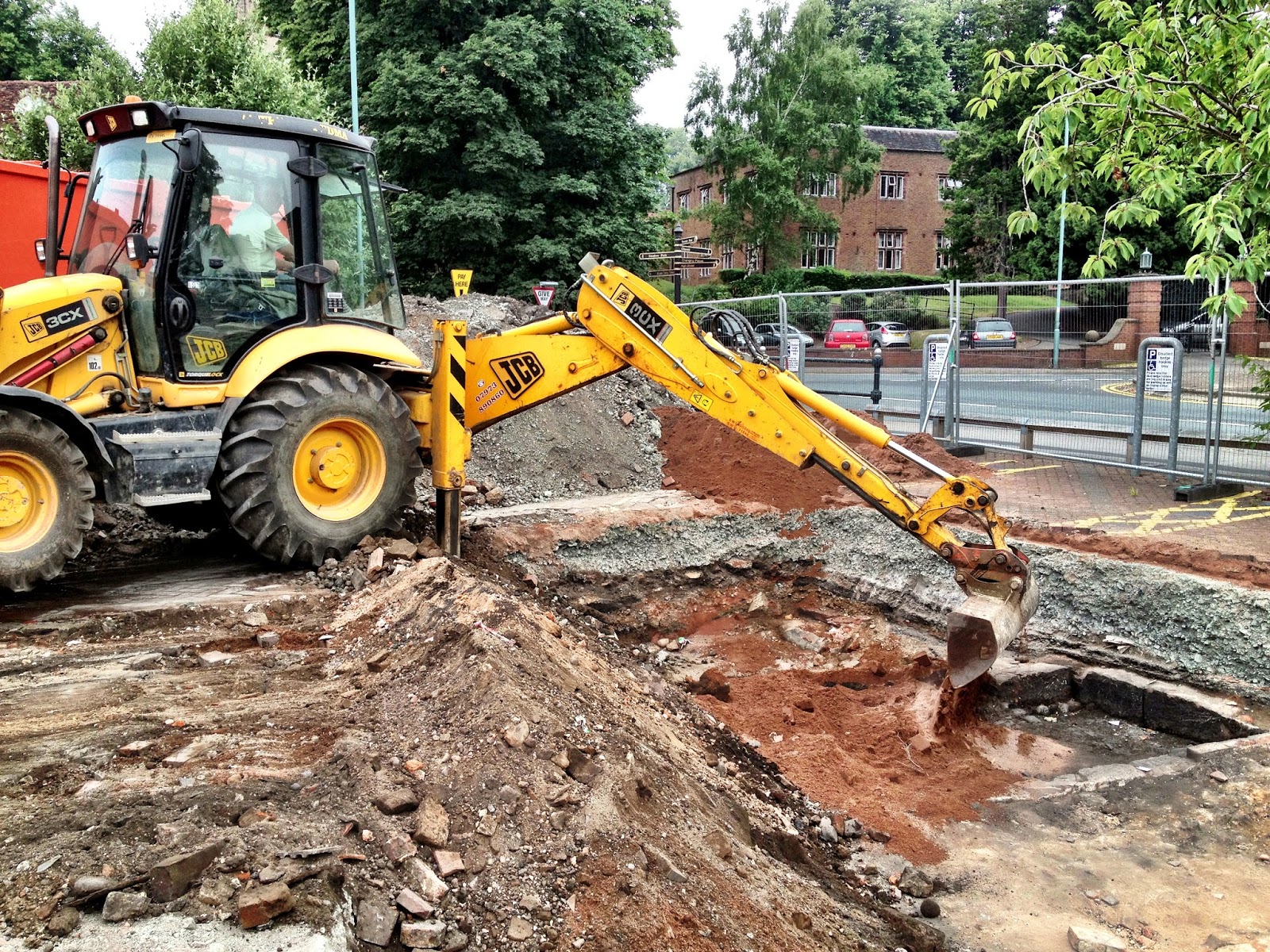
On Monday, the exhibition was packed up and moved to Bromsgrove Library, where it will remain over the summer. Pop along and take a look - some of our finds are on display along with maps, photographs and some background information. The site was filled in using a JCB, with sand being laid down first to protect the archaeological features. Many people have asked us why we can't keep it open. The answer is that, besides the obvious problems of having a large hole open in the town centre, covering the site over is the best way to protect the archaeological remains. Left exposed to the elements, sites can quickly deteriorate.
 |
| The site is backfilled by the 'Big Yellow Trowel'! Sand is laid over the top of the archaeology to protect the features. |
So what's next? Well, all the records and finds are now back at our offices in The Hive, Worcester. This week our finds volunteers have been continuing the process of cleaning, cataloguing and labelling the artefacts unearthed by the dig. They'll be analysed by our specialists, and once Site Director Richard Bradley has returned from a very well-deserved holiday, we'll begin the process of post-excavation analysis!
 |
| The finds, awaiting processing by our finds volunteers at The Hive, Worcester. The labels on each bag tell us which context the finds have come from. |
We'll continue to keep you all updated on the progress of the work, so keep checking in here to follow what we're up to. Hopefully, we'll soon have news on that tantalising piece of pottery! In the meantime, don't forget to take a look at
our photographs on Flickr - more coming soon!
Rob Hedge