Thursday, 11 July 2013

Free Tours, and a site update.

This afternoon Emma Hancox (manager of the HER and Advisory sections at Worcestershire Archive & Archaeology Service) will be leading free walking tours of historic Bromsgrove. Tours will leave from the site of the dig at 13:00,15:00 and 17:45 today. It'll be a great chance to find out more about the (often hidden!) historic character of the town. No booking required, just turn up at the site!

End of Day 2, with some intriguing features appearing!

On site, the cleaning is revealing some really striking features, such as a very heavily burnt layer, visible as the black area in the centre of the photograph. Embedded in the top of the layer is an eclectic mix of household debris such as Bakelite fittings, plates and even some Lino, baked stiff by the heat of the fire! All this household debris suggests that the fire took place around the time of the building's demolition in 1951, but what we hope to find out is whether it occurred during demolition, or immediately before. Watch this space!

if you'd like to see all of our photographs in glorious high-resolution, including our 'Finds of the day', take a look at our Flickr page.

Rob Hedge

Wednesday, 10 July 2013

Digging has begun!

Yesterday, the first of our volunteers arrived on site for the first day of the #DigBromsgrove excavation. One of the questions we were asked by a visitor is how the process of setting up an archaeological excavation takes place. So, here's a quick introduction to how we got from car park to archaeological site.


Site chief Richard Bradley directs the machining


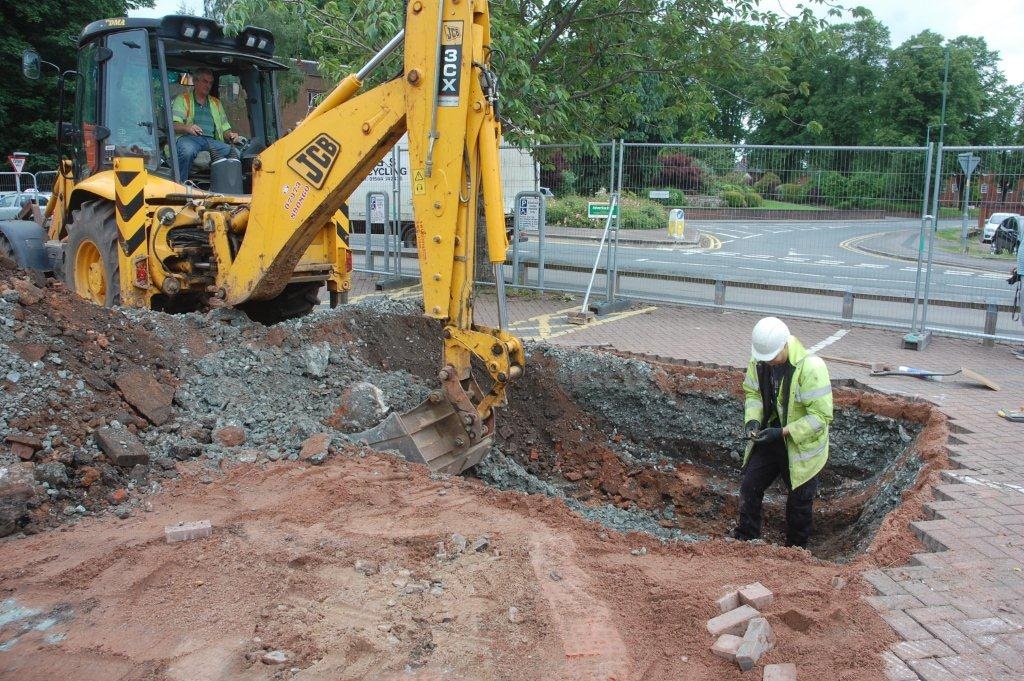
Last week, we marked out the area to be excavated, then removed the modern deposits associated with the Market Hall and car park with a JCB. The machining was directed by Richard Bradley, the archaeologist in charge of the excavation.

It may sound strange to start a delicate and painstaking archaeological dig with a big mechanical excavator, but with a skilled driver and careful supervision, it is possible to remove very precise layers of material by machine. This Youtube video is a great demonstration, as Time Team's star digger driver Ian Barclay peels a banana using an excavator! As soon as we reached the archaeological deposits underneath the modern levels, the machine stopped and we awaited the arrival of our volunteers.

The site, machined and ready to be cleaned
The first crucial task on any archaeological excavation is to give the site a good 'clean', which in archaeology-speak generally means removing any loose material left by the machine, and then scraping back the top surface of the archaeology with a trowel. The aim is not to 'dig', but rather to reveal the archaeology more clearly. A good analogy is to think of sanding a tarnished piece of wood -  removing a very thin, even slice helps to bring out the grain in the wood, as a good trowel clean helps the archaeology to show up clearly.

The 'clean' is essential because before we start 'digging' down through the deposits, we need to have a clear idea of what we're looking at across the site. It will help us to start to think about the relationships between the different phases of archaeology and features across the site, and to plan which layers we'll excavate first.

After the first day, the site is already looking a lot cleaner, and the features and deposits are starting to appear as our hard-working volunteers toil away in the sweltering heat.


Our Volunteers giving a lovely demonstration of good trowel-cleaning
 Today, we'll continue the cleaning, and hopefully we'll be able to start seeing how the archaeology in our trench matches up (or not!) to the historic maps we've been studying. Fingers crossed!

Rob Hedge

Friday, 5 July 2013

Building a Sandpit

During the course of the #DigBromsgrove excavation, we'll have around 500 school pupils coming to visit the site. We like to to give people the opportunity to get a really good experience of the way archaeology works, so, although we can't have all 500 pupils excavating on site, we have the next best thing for them to try their hand at: an archaeological sandpit, filled with interesting features and artefacts (and, of course, sand)!

So, Project Officer Richard Bradley and archaeologists Ruth Humphreys and Rob Hedge spent today building a sandpit. We resisted the temptation to take advantage of the heatwave by adding water and holding a beach party, and here are some pictures of the results. I can safely say that none of us will be looking to swap archaeology for bricklaying, but it was good fun!


Rob's Sandpit: a blank canvas!


Ruth building a feature


Richard, using a trowel for an unfamiliar purpose!


The finished article! Now to fill it with 3 tons of sand...
 We'll be opening to the public on Tuesday, when our first wave of eager volunteers arrives to take up the challenge of excavating the site. Our exhibition, with more information on the project and about historic Bromsgrove, also opens on Tuesday. Pop along and see us at 87a, High Street, Bromsgrove.

Rob Hedge.

Friday, 28 June 2013

A gem of a photograph!

Last week, we received a fantastic group of photographs of historic Bromsgrove from the Brotherton collection. Many thanks to Bob Richardson for loaning them to us! They've now been digitised by our Digitisation and Microfilming Service, and we're working through them to see if any relate to the buildings on our site.

The picture below immediately caught our eye. The accompanying notes state that it was taken in 1951, during the demolition of the houses along St John Street. Much head-scratching ensued, and we spent a long time scrutinising the historic maps and working out angles and fields of view, to try to figure out the location of the buildings being demolished.

Eventually, we cracked it, and the answer is quite exciting: they fall within our #DigBromsgrove site area! We hope to position our trench to pick up the rear wall of the building, incorporating the yard area and the boundary with the building that adjoined it to the west.

The photograph's existence is a real stroke of luck for us, as it gives us tantalising glimpses into the way this area was built and rebuilt over the years. Our buildings archaeologist, Shona Robson-Glyde, pointed out that whilst the brickwork and windows of the rear wall of the house look to date from the early 18th century, the chimney and roof structure exposed by the demolition look like they may belong to an earlier phase of building. One of the key goals for the excavation is to establish the extent to which St John Street was subject to alterations and rebuilding over the centuries, so this photograph is an encouraging indication that there may be an interesting sequence of archaeological phases on the site.

One further question remains: we'd love to know more about the cars on the left hand-side of the picture! Are you a fountain of knowledge on classic cars of the late 1940s/early 1950s? Can you help us to identify them? If so, get in touch, or leave a comment below.

Rob Hedge

St John Street during demolition, 1951. Copyright: Brotherton Collection

Tuesday, 25 June 2013

DigBromsgrove: Digging in the Records…

Background research for #DigBromsgrove is well underway! One question we've been asked about the project is 'Why Bromsgrove?', and, more specifically, 'Why the Market site?' Hopefully, this post should answer those questions!

One of the reasons we're so keen to have an excavation in Bromsgrove is that in comparison to other Worcestershire towns, Bromsgrove hasn't been the subject of much in the way of below-ground archaeological investigation. We do, however, have quite a lot of information obtained from other sources like maps, historic documents and standing buildings, in addition to clues from the street layout and landscape.

Over the winter, the Worcestershire Archaeology team completed an in depth survey of the 'historic environment' of Bromsgrove Town Centre, as part of the THI scheme. The survey looked at historic buildings in the town, as well as the historic character and land use of different areas. It brought together the knowledge gleaned from previous work like the Central Marches Historic Towns Survey (available from Worcestershire's Online Archaeology Library) and the results of other archaeological work in the town, including an extensive survey of the existing historic buildings in the town by Shona Robson-Glyde, our buildings archaeologist.

The survey identified the area around St John Street and Hanover Street as probably the earliest area of historic settlement outside of the church precinct, due to its location between Spadesbourne Brook and St John the Baptist Church, thought to have been the location of a Saxon Minster. It also backs onto the course of the Worcester to Birmingham road, a routeway of Roman origin which has remained an important transport link throughout the centuries.

The construction of the Market Hall in the 1990s revealed glimpses of the once-bustling tenement plots that occupied the site until the area was levelled in the 1950s. 16th century deposits were encountered, along with a layer of burnt material dating to the late 17th or early 18th century. Unusually for narrow tenement plots such as these, some of the foundations were partly constructed from large sandstone blocks, raising the intriguing possibility that they were re-using stone from a much earlier building on the site.

In 1994, about 40m to the southwest of our site, the excavation of a manhole led to the discovery of a sandstone wall. Fragments of a 13-14th century cooking pot were found within deposits associated with the wall. This is likely to be a remnant of the foundations of the medieval buildings that once stood on the site. The wall was located about half a metre below the modern ground level, which raises the exciting possibility that we may have medieval remains surviving in the area.

At the moment, we're working on a 'map regression', which involves analysing historic maps showing the site, 'rectifying' digital scans to ensure they are all at the same scale and orientation and then overlaying them onto one another to observe the changes to an area over time. This is all done using Geographic Information System (GIS) software which allows us to build up a picture of an area using 'layers'. In this case, each layer contains maps of a different date, which can be switched on or off to allow us to compare them quickly and accurately. Below is a nice example as a teaser - the 1884 1:10,560 Ordnance Survey 1st edition map, overlaid onto the modern OS Mapping. To see the fruits of our efforts, pop along to the public exhibition next month and have a look!

Rob Hedge


Monday, 17 June 2013

DigBromsgrove: Call for Volunteers!


Between the 9th and the 19th of July, Worcestershire Archive and Archaeology Service will be leading a Community Archaeology project in Bromsgrove. An archaeological excavation will be taking place at the Market Place, at the south end of the High Street, with an accompanying public exhibition.

The excavation will be carried out by volunteers, with full equipment, training and supervision provided by our Archaeologists.

We are looking for volunteers who can commit to at least 2 or 3 days over the course of the project, to take part in the excavation. All ages and abilities are welcome! (though being able to get in and out of a shallow trench is handy). If you'd like to get involved but don't feel that digging is for you, we're also looking for volunteers to help us to clean and process the finds and to run the public exhibition.

So, whatever your level of archaeological experience, whether seasoned digger or avid armchair archaeologist, if you're keen to get involved with an exciting project to look at a little-explored area of historic Bromsgrove, get in touch with David Thomas with details of when you'd like to take part and what you'd like to do:

            David Thomas, THI Officer
            Tel: 01527 881343
            d.thomas@bromsgrove.gov.uk

Over the course of the project, you'll be able to follow the progress of the excavation and the background research via this blog.

We'll also be featuring finds, interviews with participants and behind-the-scenes updates on a variety of different social media platforms. Follow the hashtag #digbromsgrove to keep up-to-date with the project.